

 Pretreatment equipments
 Micro filtration
 Water disinfection
 Water testing equipment
 Water treatment chemical
 Specialized pumps
 Swimming pool equipment
 Other products
 Chemical dosing system
 Water treatment system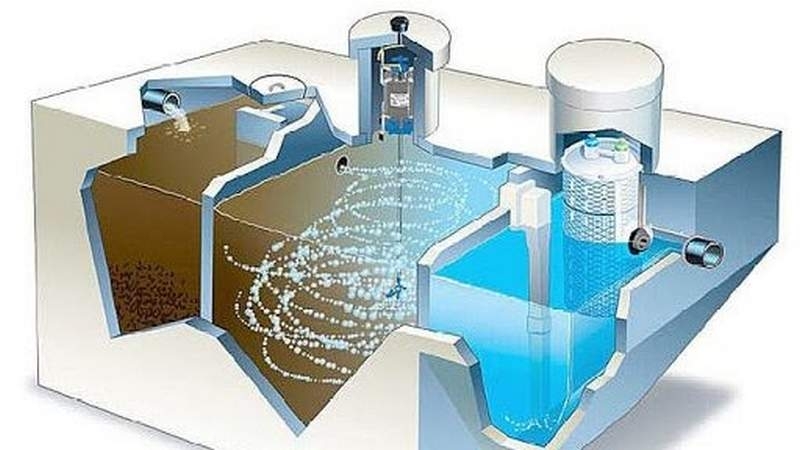
Nowadays, there are many units using advanced wastewater treatment technologies that bring high efficiency, maximum cost and time savings. In fact, the use of wastewater treatment technology is focused on by many companies to bring users the best experience. Below are the top 5 modern and optimal wastewater treatment technologies that you should know.
Aerotank wastewater treatment technology
Aerotank wastewater treatment technology is a biological method using aerobic activated sludge to decompose organic substances in wastewater. This technology is widely applied in domestic and industrial wastewater treatment thanks to its high efficiency, simple operation and reasonable cost.
Operation principles
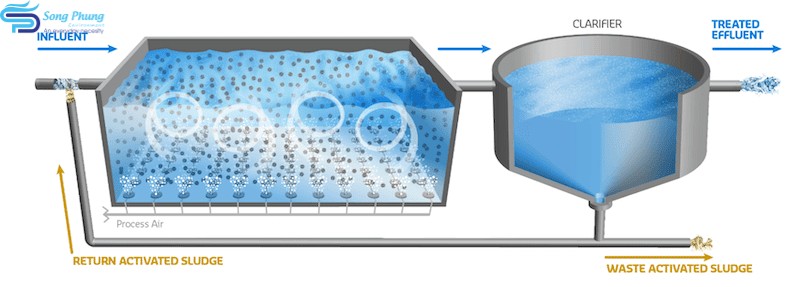
Aerotank is an aerobic biological tank in which microorganisms use oxygen to decompose organic matter in wastewater. This process takes place through the following main stages:
- Aeration: Oxygen is continuously supplied to the tank to maintain aerobic conditions, helping microorganisms grow.
- Organic matter decomposition: Microorganisms in activated sludge absorb and decompose organic matter into CO₂, H₂O and new biomass.
- Sludge settling and circulation: After the treatment process, the activated sludge settles, a part is circulated back to the tank to maintain the necessary amount of microorganisms, the remaining part is treated separately.
Benefits of Aerotank technology
- High treatment efficiency: Significantly reduces BOD, COD and SS in wastewater.
- Low operating costs: Due to the use of natural microorganisms, no need for many chemicals.
- Easy to expand and upgrade: Size and capacity can be adjusted according to needs.
- Suitable for many types of wastewater: Applied in the treatment of domestic wastewater, hospitals, food, textile dyeing…
Drawbacks
- Large tank area required: Due to long water retention time.
- High energy costs: Aeration systems consume electricity.
- Need to control activated sludge concentration: Too much or too little will affect the treatment efficiency.
Aerotank technology has many variations such as traditional Aerotank, extended Aerotank, multi-stage Aerotank, helping to optimize wastewater treatment capacity according to specific conditions.
USAB wastewater treatment technology
UASB (Upflow Anaerobic Sludge Blanket) is an anaerobic wastewater treatment technology based on the reverse flow principle. The treatment process takes place in an anaerobic reactor, where microorganisms decompose organic matter in wastewater and produce biogas.
Operation Principles
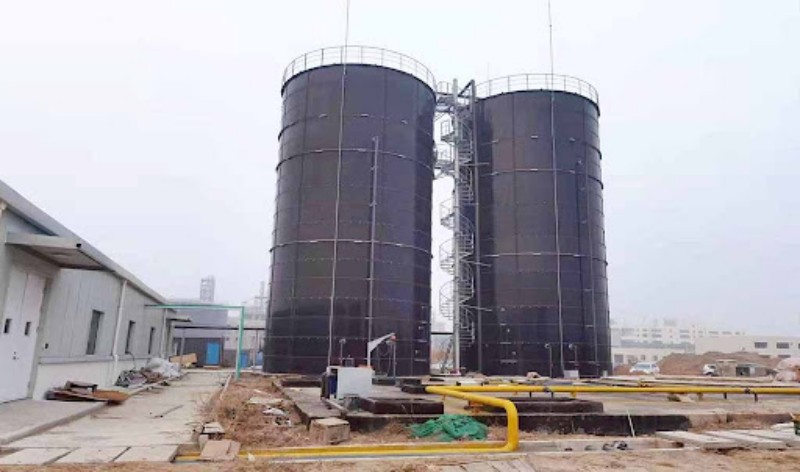
The UASB tank is designed with the counter-flow principle and includes three main zones:
- Anaerobic sludge zone: This is a layer of sludge containing anaerobic microorganisms that are responsible for decomposing organic matter in wastewater.
- Settling zone: In this area, activated sludge will settle to continue treating wastewater, helping to maintain a stable amount of microbial sludge in the tank.
- Gas collection zone: Biogas produced during the decomposition process is collected and can be used as fuel.
The processing takes place
- Step 1: Wastewater flows in from the bottom of the UASB tank, in contact with the anaerobic sludge layer.
- Step 2: Microorganisms decompose organic matter, creating methane (CH₄) and CO₂.
- Step 3: Biogas adheres to the sludge, forming air bubbles that push the sludge up, then the sludge settles down and continues to treat the wastewater.
- Step 4: Wastewater after passing through the UASB tank will continue to be treated with other technologies (Aerotank, MBBR…) to ensure it meets standards before discharge.
Benefits of UASB technology
- High treatment efficiency: Can remove 80-90% of BOD, COD, helping to effectively treat wastewater with high concentrations of organic pollutants.
- Energy saving: No need for aeration like aerobic technologies, helping to significantly reduce power consumption.
- Biogas generation: Methane gas produced can be used to produce electricity or as fuel for boilers, helping to save operating costs.
- Reduced sludge volume: Compared to aerobic technology, less sludge is produced, helping to reduce sludge treatment costs.
- Low operating costs: Due to not using too much energy and chemicals, UASB technology has lower operating costs than traditional aerobic wastewater treatment technologies.
MBBR wastewater treatment technology
MBBR (Moving Bed Biofilm Reactor) wastewater treatment technology is an advanced biological method, using mobile media to enhance the wastewater treatment process. This system combines elements of activated sludge treatment and biological filtration, to improve treatment efficiency without requiring large space or changing the existing system structure.
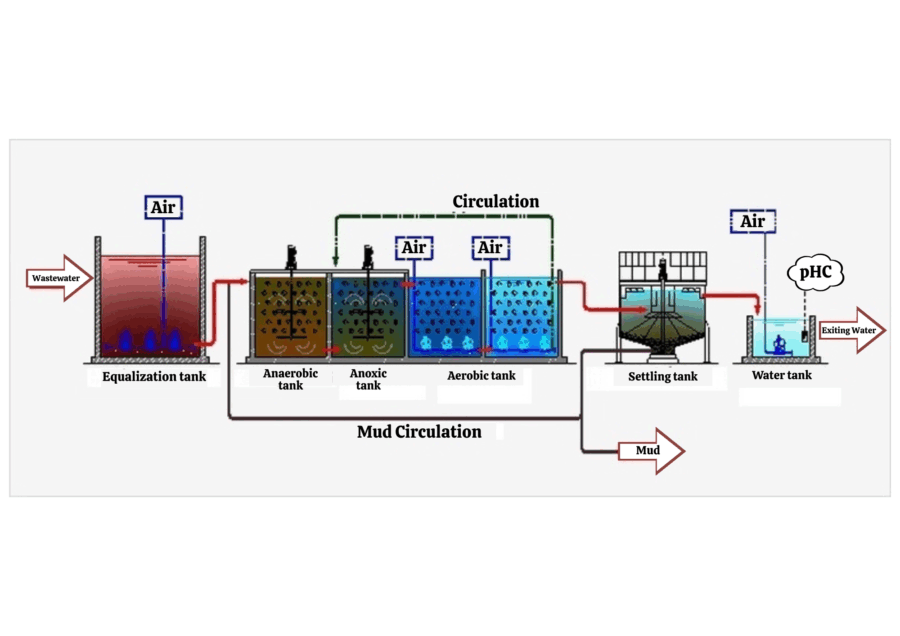
MBBR wastewater treatment process
Wastewater is fed into a tank containing mobile carriers, usually plastic beads with a large surface area for microorganisms to adhere to and develop into biofilms. These carriers are continuously moved in the tank by air flow or agitation system, creating optimal conditions for microorganisms to decompose organic pollutants.
Benefits
- High processing efficiency
- Space saving
- Easy operation and maintenance
- High load handling capacity
Applications
Industrial wastewater treatment is widely used in industries such as textile, food, chemical, and paper. Effective in treating organic pollutants and pathogenic microorganisms from medical wastewater.
Detailed Research: Top 5 most modern and optimal wastewater treatment technologies today
AAO (A2O) treatment technology
AAO (Anaerobic-Anoxic-Oxic) wastewater treatment technology, also known as A2O, is a biological method that combines three different treatment stages to remove organic matter, nitrogen and phosphorus in wastewater. This method is designed to optimize nutrient removal, especially in urban and industrial wastewater treatment systems.

AAO wastewater treatment process
- Anaerobic stage: The influent wastewater is fed into the anaerobic tank, where there is no oxygen. In this process, anaerobic bacteria decompose complex organic compounds into simpler substances.
- Anoxic stage: After passing through the anaerobic stage, the wastewater is transferred to the anoxic tank. Here, facultative bacteria use nitrate (NO3-) as an oxygen source to decompose the remaining organic substances
- Aerobic stage: The wastewater is fed into the aerobic tank, where oxygen is continuously supplied. In an oxygen-rich environment, aerobic bacteria continue to decompose the remaining organic compounds.
Benefits
AAO technology is particularly effective in removing both nitrogen and phosphorus, helping to prevent eutrophication in aquatic environments. The combination of three treatment stages optimizes the decomposition of organic matter and the removal of pollutants, ensuring greater efficiency than methods using only one stage.
Applications
Widely used in municipal wastewater treatment plants where effective treatment of nutrients from domestic wastewater is required. Applied in food, beverage, and other industries with wastewater containing high nutrients.
See more: Domestic water treatment process meets required standards
MBR biological membrane filter
MBR (Membrane Bioreactor) is an advanced wastewater treatment technology that combines biological processes and membrane filtration to remove suspended solids and harmful microorganisms. This system is highly effective in wastewater treatment, allowing the reuse of treated water.
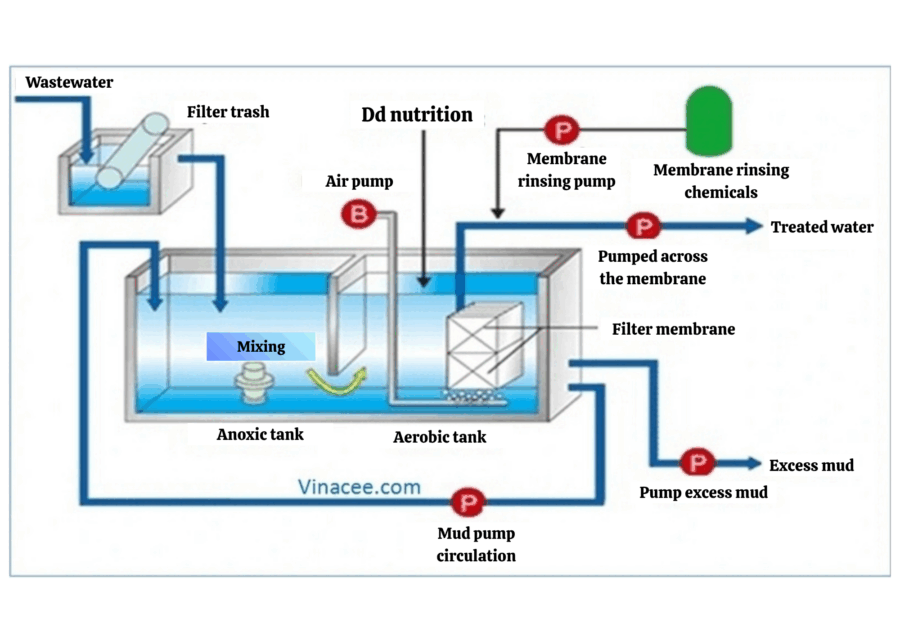
MBR wastewater treatment process
Wastewater is fed into a biological tank where microorganisms decompose organic matter in the wastewater. After passing through the biological tank, the wastewater is filtered through ultrafiltration or microfiltration membranes. The water after passing through the membrane can be of high quality, safe for reuse or discharge into the environment.
Benefits
Effectively removes suspended solids, bacteria and microorganisms. MBR systems save space compared to traditional systems.
Applications
MBR bio-filter is suitable for treating urban wastewater; Industrial wastewater; Residential areas and large buildings.
See more: Safe and effective industrial wastewater treatment technologies
SBR wastewater treatment technology
SBR (Sequencing Batch Reactor) wastewater treatment technology is a biological method that uses cyclically operated reactors to treat wastewater. This system treats wastewater in separate stages in a single tank, providing high flexibility and efficiency.

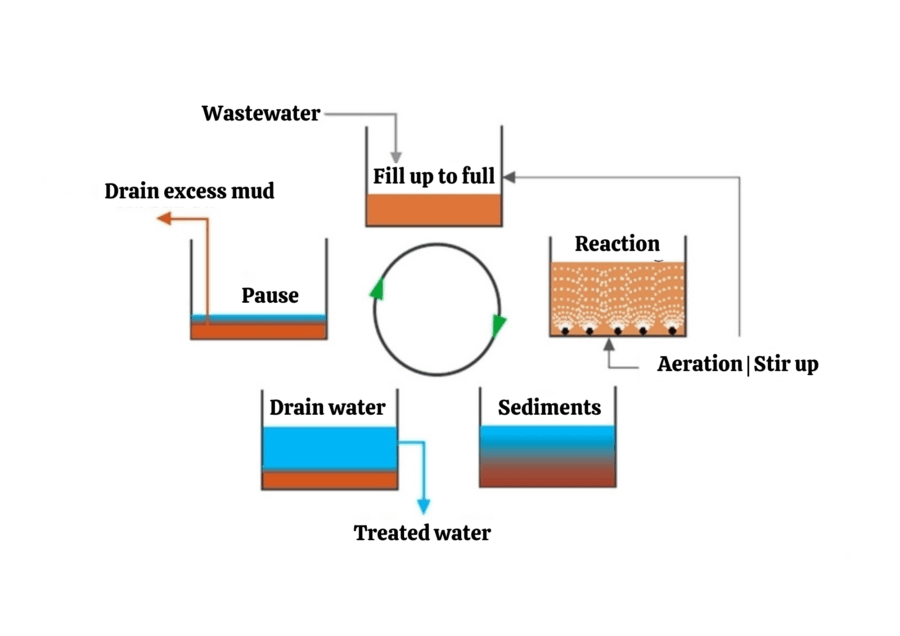
SBR technological process
Wastewater is fed into a reactor. Microorganisms in the reactor decompose organic matter and nutrients in an aerobic environment. After the reaction, the system stops supplying air so that the solids settle to the bottom of the tank.
Benefits
- Flexible and easy to adjust
- Space saving
- High processing efficiency
- Easy to operate and maintain
Applications
With SBR wastewater treatment technology will suit most of the user’s needs. However, suitable for small scale areas and flexible treatment requirements.
Chemical and biological technology
Physio-chemical and biological wastewater treatment technology is a method that combines chemical, physical and biological processes to remove pollutants in wastewater. This method takes advantage of each process to achieve optimal treatment efficiency.
Chemical and biological technology processes
Benefits
Combine methods to optimize pollutant removal. Easily adjust and combine processes to accommodate a variety of wastewater types. Minimize negative environmental impacts by comprehensively treating pollutants.
Applications
Physical-chemical and biological technologies applied in small-scale areas with diverse treatment requirements.
Further research: Aquaculture wastewater treatment process meets required standards
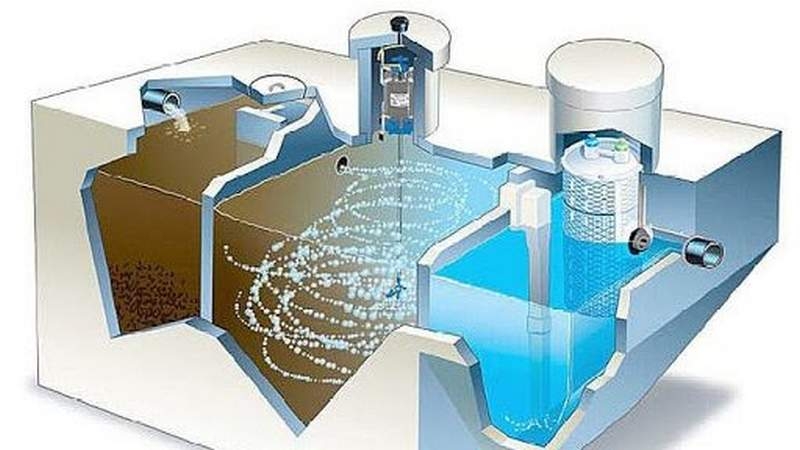
Johkasou wastewater treatment technology from Japan
Johkasou is an advanced Japanese wastewater treatment technology, designed to effectively treat domestic wastewater from households, residential areas, hotels, schools and small factories. The Johkasou system operates on the principle of multi-level integrated treatment, including mechanical, anaerobic, aerobic and disinfection biological processes in one compact unit.
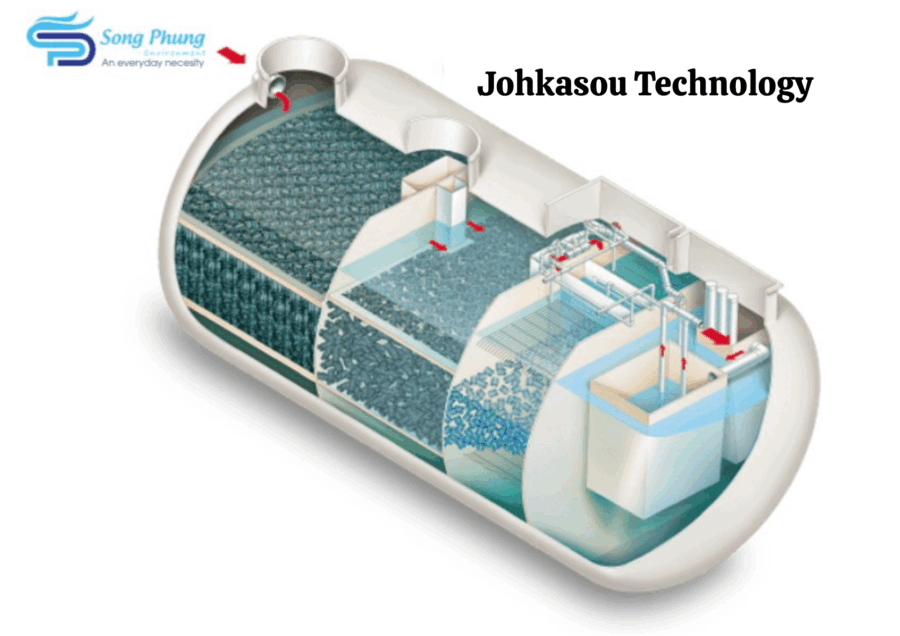
Operation Principles
The Johkasou system usually consists of 5 main tanks, each tank has a different function:
Primary settling tank (Mechanical)
- Separates coarse debris and heavy sediment from the influent wastewater.
- Reduces solids loading before entering the biological stage.
Anaerobic tank (Anaerobic biological treatment)
- Anaerobic microorganisms decompose organic matter in wastewater.
- Helps reduce BOD, COD, and limit sludge production.
Aerobic tank (Aerobic biological treatment – Aerotank)
- Provides oxygen for aerobic microorganisms to decompose organic matter.
The nitrification process occurs, converting Ammonium (NH₄⁺) into Nitrate (NO₃⁻).
Secondary settling tank (Sludge separation – sludge circulation)
- Microbiological sludge settles, clear water flows through the disinfection tank.
- Part of the sludge is recycled back to the aerobic tank to maintain the microbiological system.
Disinfection tank (Chemical/UV treatment)
- Remove remaining bacteria and pathogens with chlorine or UV light.
- Ensure the output water meets discharge or reuse standards.
Criteria when choosing wastewater treatment technology
Choosing wastewater treatment technology is an important process, directly affecting treatment efficiency, costs and environmental protection. Below are the criteria to consider when choosing wastewater treatment technology:
- Characteristics of wastewater: Domestic, industrial, medical or agricultural.
- Composition and concentration of pollution: Including organic substances, nutrients, heavy metals, and microorganisms.
- Flow and load: The level of fluctuation of flow and pollution load over time.
- Treatment efficiency: Evaluate the ability to remove BOD, COD, TSS, nitrogen, phosphorus and pathogenic microorganisms.
- Cost: Including initial investment costs and operating and maintenance costs.
See more: Technology for treating electroplating and metal wastewater to meet required standards
Prestigious and professional wastewater treatment system installation unit
With over 10 years of experience in the field of environmental treatment, Song Phung Environment is proud to be a prestigious unit specializing in consulting, designing and installing wastewater treatment systems nationwide. We provide modern, cost-optimized solutions and ensure that the treated wastewater meets the standards prescribed by the Ministry of Natural Resources and Environment. Below are the top reasons for you to trust and cooperate with us.
- Prestige and experience: With many years of experience in the wastewater treatment industry, Song Phung Environment has affirmed its position as one of the leading units in Vietnam. We have successfully implemented hundreds of large and small projects, from factories to residential areas and hospitals.
- Advanced technology: We always update and apply the most advanced wastewater treatment technologies in the world, ensuring the system operates effectively, saves costs and is environmentally friendly.
- Professional team: Our team of engineers and technicians are highly qualified, experienced and dedicated to their work. We will advise, design and construct wastewater treatment systems suitable to the characteristics and needs of each business.
- Comprehensive service: Song Phung Environment provides a full range of services, from survey, design, construction, installation, operation, maintenance and servicing of wastewater treatment systems. We are committed to accompanying businesses throughout the entire operation of the system.
- Competitive price: We always offer the most competitive prices on the market, suitable for each business’s budget.
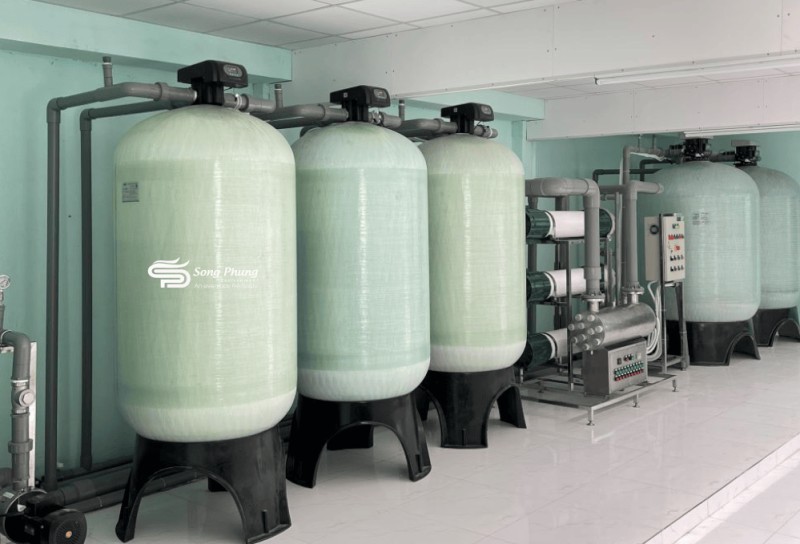
Above is the information about wastewater treatment technology that we want to provide to you. If you are looking for the perfect water treatment solution, let Song Phung accompany you!
Other services at Song Phung:
Contact hotline 0913907274 for free consultation!
